











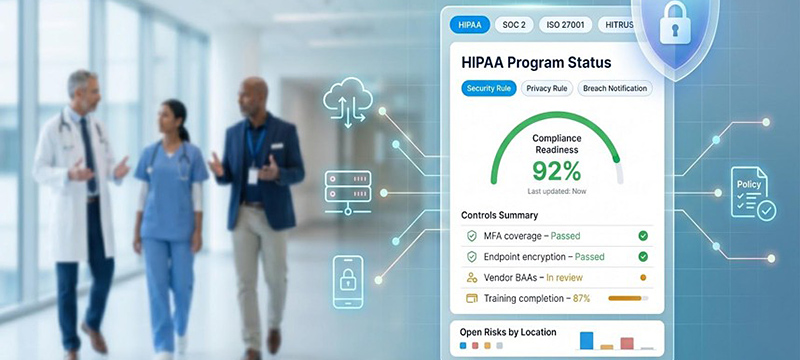
This article compares five leading HIPAA compliance software platforms for healthcare organisations.
1. Vanta: best for automation-first healthcare tech teams (especially Business Associates)
Vanta is a trust management and compliance automation platform built for teams that want HIPAA to run like an always-on system check, not a once-a-year scramble. It is a strong fit for cloud-native healthcare SaaS companies and other Business Associates handling ePHI that also need to scale into SOC 2, ISO 27001, or HITRUST over time.
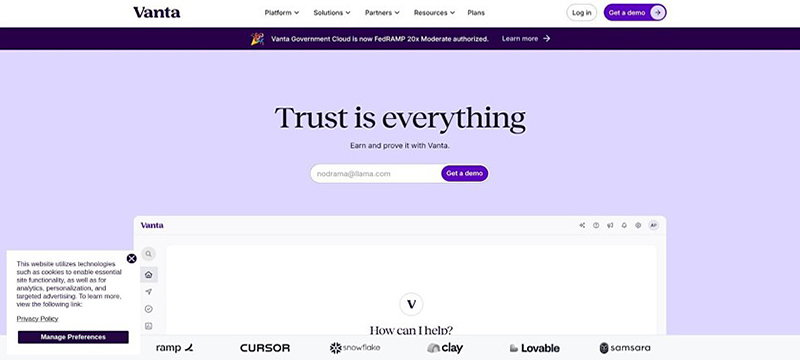
HIPAA coverage note: Vanta supports the HIPAA Security Rule and Breach Notification Rule, but it does not cover the HIPAA Privacy Rule. That distinction matters. If you are a Covered Entity (like a hospital system, health plan, or clearinghouse) and need Privacy Rule workflows in the platform, you will likely need a different tool.
Where Vanta stands out is automation depth. It connects to 400+ cloud and DevOps services and runs tests on a frequent cadence (about every 1 to 2 hours), using a HIPAA program mapped to 73 controls with roughly 123 automated and manual tests. In practice, that means you can continuously verify common requirements like MFA, encryption, access provisioning, and device posture, receive instant alerts whenever a control test fails—a workflow detailed in Vanta’s risk tracking module—and route issues into tools like Jira for remediation.
Vanta also covers the administrative side that tends to eat up time:
- Policies: 18 total policies, including 6 HIPAA-specific, with tooling to customize and manage updates.
- Training: Built-in HIPAA training is included, with an option to integrate with KnowBe4 if you want deeper security-awareness content.
- Vendor and BAA tracking: BAAs and vendor risk can be managed through Vanta’s vendor risk management workflows, so third-party compliance does not live in scattered folders.
- Breach readiness: Includes templates and workflows aligned to breach-notification obligations for Business Associates.
If you are running more than one framework, Vanta’s control mapping can materially reduce rework. For many teams, HIPAA overlaps meaningfully with SOC 2, ISO 27001, and HITRUST, so you can reuse evidence and controls rather than rebuilding your program from scratch.
Implementation and audit readiness: HIPAA in Vanta is self-attested, so there is no external HIPAA audit timeline to manage. Teams starting from zero typically get stood up in a few weeks to a few months, and organisations with an existing SOC 2 program can often move faster because a portion of controls are already satisfied.
Pricing: HIPAA can be included as a package framework or priced as a $5,000 per year add-on, with total first-year costs commonly landing in the $10,000 to $15,000+ range depending on company size and add-on modules.
Pros: deepest automation in this list (400+ integrations and frequent test cycles), strong cross-framework reuse if you are doing HIPAA plus SOC 2 or HITRUST, and self-attestation avoids audit fees and scheduling bottlenecks.
Cons: no Privacy Rule support (a deal-breaker for many Covered Entities), no native EHR integrations like Epic or Cerner out of the box, and it can be overkill for small clinics that do not run a cloud-heavy stack.
Customer proof: Hummingbird Healthcare achieved SOC 2 Type 1 plus HIPAA in 3 months. Other reported outcomes include Modern Health saving 100+ hours annually, Vibrent Health reducing vendor review time from 100 hours to a few hours per week, and ITx Companies seeing 41 per cent of HIPAA controls pre-populated from an existing SOC 2 program.
2. Compliancy Group (The Guard): best for clinics that want hands-on coaching
Compliancy Group’s platform, The Guard, is built for healthcare organisations that want a guided path to HIPAA compliance with a real person in the loop. If your biggest bottleneck is not tooling, but knowing what to do next and how to document it correctly, this is one of the most straightforward options on the market.
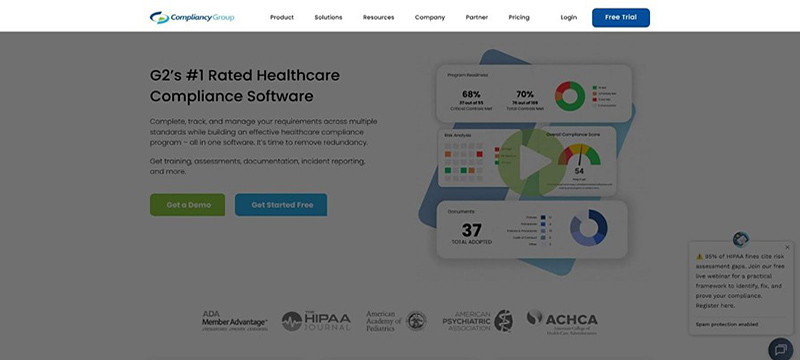
Best for: small to mid-sized healthcare practices that want a step-by-step workflow and ongoing support, especially teams without dedicated IT or compliance staff.
Unlike many “compliance automation” platforms that focus primarily on technical evidence collection, Compliancy Group emphasises complete HIPAA program coverage. The Guard supports the Security Rule, Privacy Rule, and Breach Notification Rule, and also offers an OSHA add-on for healthcare organisations.
Core capabilities centre on helping you build and maintain the administrative backbone HIPAA expects:
- Security Risk Analysis (SRA): guided risk assessments with corrective action planning, typically completed in 30 days or less on average (vendor case-study data), with your coach helping you keep momentum.
- Policies and procedures: a library of 500+ templates you can customize to your environment.
- Workforce training: built-in training with completion tracking, so training records are not trapped in spreadsheets.
- Vendor and BAA tracking: tools to manage vendors and agreements, plus reminders around renewals.
- Incident management: workflows to document and track incidents and potential HIPAA violations.
Automation depth: high for documentation workflows, training tracking, and program management. It is not designed for real-time technical monitoring of your infrastructure (for example, continuously verifying MFA, encryption settings, or cloud configuration drift). If your main goal is automated technical evidence collection across cloud systems, you will still need additional security tooling or a different platform category.
Implementation and rollout: many organisations use the coach-led workflow to complete their initial SRA quickly, then expand into policies, training, vendor management, and incident documentation over the next 1 to 3 months depending on size and complexity.
Pricing: Compliancy Group introduced modular pricing in May 2025 starting at $99 per month, letting practices choose the pieces they need. Previous “full suite” pricing was often positioned closer to the mid-hundreds per month, so the new packaging is a meaningful shift for smaller clinics.
Pros: dedicated coach support throughout the process, full HIPAA coverage including the Privacy Rule, and a large policy template library backed by long healthcare compliance experience.
Cons: limited technical integrations and no continuous infrastructure control testing, plus a coach-driven model that can feel slower for teams that prefer fully self-serve execution.
Stand-out differentiator: the assigned live compliance coach. For many clinics, that is the difference between “we bought software” and “we finished the program.”
Customer proof: Compliancy Group positions itself as serving 4,000+ organisations and cites a 100% client audit pass rate claim, alongside strong category positioning on G2 for healthcare compliance.
3. Accountable HQ: best for a self-serve, tiered HIPAA program that grows with you
Accountable HQ is a practical choice when you want a single portal for HIPAA basics, but you are not ready for an enterprise GRC rollout. It is built for clinics and healthcare startups that prefer a self-serve workflow, with higher tiers adding more security-forward features as your program matures.
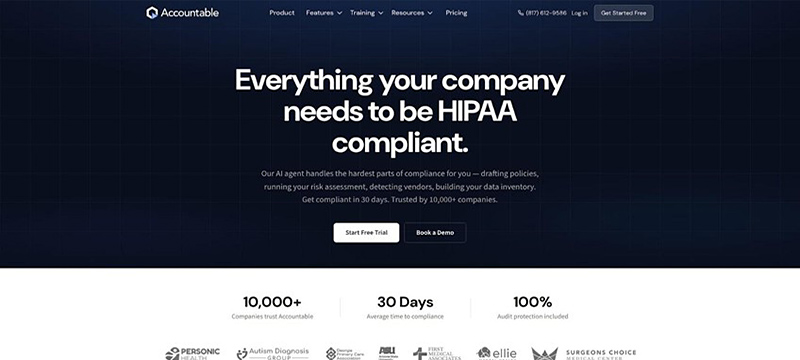
Best for: small to mid-sized practices and digital health teams that want full HIPAA coverage (including the Privacy Rule) with a clear upgrade path from “baseline compliance” to more proactive monitoring.
Accountable HQ covers HIPAA Security, Privacy, and Breach Notification requirements, and bundles the day-to-day components most teams need to prove they are operating a real program:
- Security risk assessment: a guided Security Risk Assessment workflow included in all plans.
- Policies and procedures: policy generation and management tools across tiers.
- Training: HIPAA training plus security awareness training in the Basic tier, with additional courses available in higher tiers.
- BAA and vendor management: BAA management is included, and the Plus tier adds vendor discovery and shadow IT detection.
- Incident and breach readiness: incident-response tooling is included, with the Plus tier adding data breach monitoring.
Automation depth: moderate. Accountable HQ includes an AI Compliance Copilot across all tiers, and the Plus tier adds more “push-button” security workflows like phishing simulation, MFA and access controls review, and data breach monitoring. The Pro tier goes further with vulnerability scanning twice per year and penetration testing once per year. What it does not offer is the kind of deep, always-on evidence collection you get from platforms built around large-scale cloud integrations.
Implementation timeline: Accountable HQ advertises an average of 30 days to compliance (vendor claim), and you can start immediately via a 7-day free trial.
Pricing: Accountable HQ uses a tiered subscription model with included employee counts and per-seat add-ons:
- Basic HIPAA: $169/month on annual billing ($199/month monthly), includes 15 employees, then $9 per additional seat
- Plus: $254/month annual ($299/month monthly), includes 15 employees, then $15 per additional seat
- Pro: $679/month annual ($799/month monthly), includes 20 employees, then $19 per additional seat
Month-to-month pricing is listed as higher than annual, and plans are positioned as cancel-anytime.
Pros:
- Full HIPAA rule coverage, including the Privacy Rule, which makes it viable for Covered Entities
- Strong value in the Plus tier for the price point, including phishing simulation, vendor discovery, and breach monitoring
- Clear pricing and packaging, with a fast way to trial the product
Cons:
- Not a multi-framework platform (no SOC 2, ISO 27001, or HITRUST program mapping)
- Limited deep technical integrations compared to cloud-native compliance automation platforms
- Per-seat pricing can climb quickly as you scale headcount
Stand-out differentiator: the Plus tier bundles several proactive security features that many HIPAA tools reserve for higher-priced plans, including phishing simulation, vendor discovery/shadow IT detection, MFA review, and data breach monitoring.
Customer proof: Accountable HQ states 10,000+ companies use the platform (vendor claim) and positions the product around a 30-day average time to compliance (vendor claim), with “audit protection” included in plans.
4. HIPAA One (Intraprise Health): best for audit-grade risk analysis
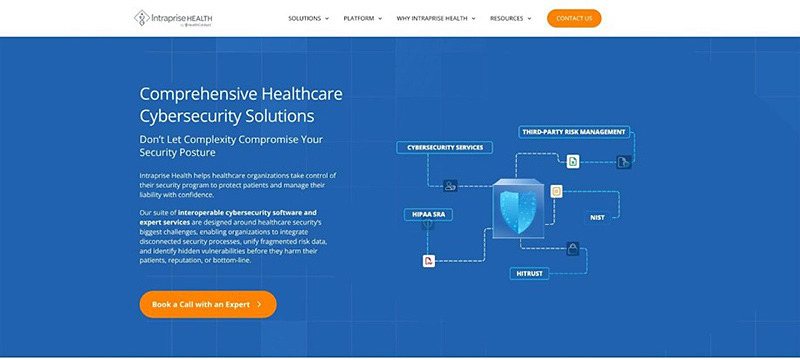
HIPAA One, now part of Intraprise Health, is built for organisations that need a defensible, auditor-ready Security Risk Analysis (SRA) and want the output to match what regulators actually look for. This is less about lightweight policy wizards and more about producing a risk analysis that stands up under scrutiny across multiple facilities, business units, and affiliates—essentially functioning as a comprehensive risk assessment and management software approach.
Best for: hospitals, health systems, and multi-site networks that want an OCR-aligned SRA with enterprise reporting, weighted scoring, and roll-up visibility.
HIPAA One’s core strength is that its SRA workflow mirrors the OCR audit protocol closely, and it is grounded in NIST methodology (including NIST SP 800-66 alignment). That gives compliance and security leaders a clear line from “requirement” to “evidence” to “remediation plan,” which is exactly what you need when leadership asks, “Are we audit-ready?”
What it covers depends on the modules you deploy, but the platform supports full HIPAA program needs across:
- Security Rule: the SRA experience, including automated risk calculation, prioritisation, and remediation planning
- Privacy Rule and Breach Notification: supported through dedicated modules (for example, Privacy and privacy/breach risk assessment functionality)
- Business associate workflows: contract and agreement management via a Business Associate Manager (BAM) capability
- Workforce training: a training module is available, with progress tracking and reporting
On the automation front, HIPAA One is strong at streamlining assessments and enterprise coordination. It can accelerate year-over-year work by carrying forward prior assessment data, and it supports parent-child roll-ups so multi-entity organisations can view results at the facility level and the system level. It is not positioned as a “connect to every cloud service and test controls hourly” platform. The automation is primarily assessment workflow, scoring, and reporting, not continuous technical control testing across your infrastructure.
Implementation: timelines vary by delivery model. Intraprise Health offers self-service, hybrid, and managed services approaches, which lets organisations choose between software-led execution and deeper expert involvement. Case-study data cited in the draft suggests meaningful time reductions after rollout (for example, a reported 65 per cent reduction in SRA preparation time in one deployment).
Pricing: enterprise pricing is typically quote-based, and overall cost depends on modules and whether you choose managed or hybrid services.
Pros:
- OCR-audit-protocol alignment and NIST-based approach create a more defensible SRA
- Built for multi-site complexity, including roll-up reporting across sub-entities
- Flexible delivery models (self-service, hybrid, managed) to match internal resourcing
Cons:
- Enterprise packaging and services can make total cost high for clinics and small practices
- Monitoring is largely compliance-process and assessment focused, not real-time infrastructure scanning
- Some functionality may be modular depending on your package, which can increase complexity during procurement
Stand-out differentiator: HIPAA One is purpose-built to generate an SRA in the format and depth auditors expect. If your priority is “audit-grade SRA with enterprise reporting,” it is one of the most direct fits in this list.
Customer proof: Intraprise Health positions HIPAA One as used by 16,000 users across 10,000+ healthcare organisations, and cites a 100% OCR acceptance rate claim, along with additional case-study improvements in SRA efficiency (vendor-stated metrics).
5. Clearwater IRM|Pro: best for enterprise-scale risk governance (plus managed security)
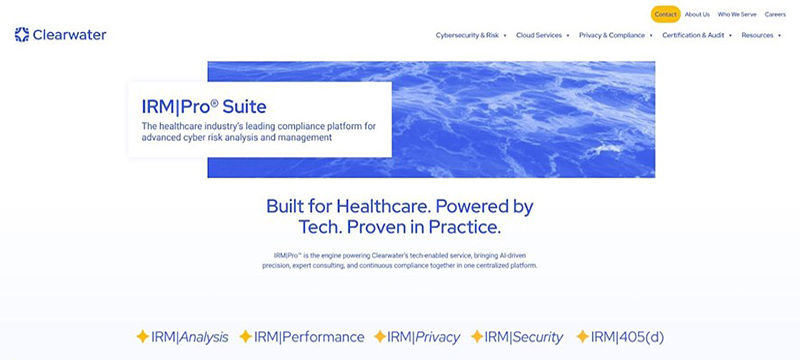
Clearwater IRM|Pro is built for healthcare organisations that need more than a HIPAA checklist. It is a fit when your program spans thousands of assets, multiple facilities, medical devices, and third parties, and you want a single partner that can deliver both the platform and the expertise to run it.
Best for: enterprise health systems, IDNs, hospital chains, and large practice management groups that want healthcare-specific risk modelling and the option to pair it with advisory services and managed security.
Clearwater’s HIPAA coverage is delivered through a suite of modules designed to map to the real shape of a healthcare compliance and security program:
- IRM|Analysis: Security Risk Analysis (SRA) aligned to NIST and designed to be OCR-quality, covering ePHI assets and medical devices.
- IRM|Security: Security Rule compliance assessment workflows.
- IRM|Privacy: Privacy Rule and Breach Notification Rule coverage.
- IRM|405(d) HICP: alignment to the industry-recognised cybersecurity practices published under HICP.
Where Clearwater differs from lighter HIPAA tools is in how it treats “continuous monitoring.” The software supports enterprise-wide risk calculation, prioritisation, and executive reporting, but the always-on component comes from Clearwater’s broader delivery model. Clearwater also offers managed security services with a 24/7 SOC, plus managed cloud services for Azure environments. For CISOs, that means you can combine compliance reporting, risk remediation planning, and active security operations under one vendor relationship.
Automation depth: high for enterprise risk modelling and reporting, and operationally continuous when paired with the managed services layer. This is not a self-serve compliance automation product built around hundreds of plug-and-play integrations. It is a healthcare-focused platform that becomes most valuable when used alongside Clearwater’s advisory and managed security capabilities.
Multi-framework support: Clearwater’s software is healthcare and HIPAA centred, with additional alignment to NIST and 405(d) HICP. Broader frameworks like HITRUST and SOC 2 are typically supported through Clearwater’s compliance services rather than out-of-the-box cross-framework control mapping.
Implementation: expect a multi-month rollout for enterprise organisations. Deployment usually includes discovery and inventory, risk analysis, remediation planning, and establishing ongoing governance rhythms. Managed services run continuously once engaged.
Pricing: Clearwater is positioned at a six-figure total cost of ownership and is sold through a consultative process. The expert research notes an estimated annual investment in the $150k to $500k+ range for a mid-size health system depending on scope, modules, and services.
Pros:
- Deep healthcare-specific risk modelling across servers, IoMT, third-party portals, and medical devices
- Full HIPAA program coverage via dedicated modules, including Privacy and Breach Notification support
- Option to pair compliance governance with a 24/7 SOC and managed security services for a unified operating model
Cons:
- Cost and scope make it impractical for small clinics and early-stage startups
- Value depends on time and engagement; it is not “buy it and you are done” software
- Less oriented toward plug-and-play cloud evidence collection compared to automation-first compliance platforms
Stand-out differentiator: Clearwater is the only option in this list that combines enterprise compliance software with a full managed security practice, including a 24/7 SOC. If you want a platform plus a partner to help operate the program, that is the defining advantage.
Customer proof: Clearwater cites 500+ customers, 20+ years focused on healthcare cybersecurity, and recognition including 2026 Best in KLAS for Security & Privacy Consulting, Black Book #1 (survey of approximately 2,000 executives), and MSSP Alert Top 250, alongside a 100% OCR success rate claim (vendor-stated metrics).
Quick-scan comparison
Use this table to narrow your shortlist fast, then validate fit in demos based on your HIPAA rule coverage needs (especially Privacy Rule), automation expectations, and budget model.
| Platform | Ideal for | Stand-out strength | Deployment | Starting price* |
| Vanta | Cloud-native health-tech teams and Business Associates | 400+ integrations, frequent automated testing | SaaS | HIPAA included as a package framework or $5,000/year add-on (total varies by add-ons) |
| Compliancy Group (The Guard) | Clinics that want a human coach | Dedicated coach plus full HIPAA (including Privacy Rule) | SaaS | from $99/month (modular pricing) |
| Accountable HQ | Practices that want self-serve, tiered HIPAA | Tiered plans with AI Copilot and strong Plus-tier add-ons | SaaS | 7-day free trial, then from $169/month (annual) |
| HIPAA One (Intraprise Health) | Multi-site hospital networks | OCR-aligned, audit-grade SRA with roll-up reporting | SaaS | Quote required |
| **Clearwater IRM | Pro** | Large IDNs and enterprises | Enterprise risk governance plus managed security options | SaaS or hybrid |
Conclusion
HHS’s January 2026 draft HIPAA Security Rule update would make full encryption and multi-factor authentication (MFA) mandatory for every system that touches ePHI. The final text is expected later this year, with a 180-day compliance window, so you will need proof fast, not promises.
The threat side is moving just as quickly. Ransomware hit small providers six times more often in 2025 than in 2021, and the average healthcare breach now tops USD 10.9 million. Continuous monitoring is often cheaper than a single incident response.
Practical steps to stay ahead:
- Embed continuous risk monitoring. Connect your compliance platform to EHRs, cloud accounts, and mobile-device managers so drift triggers an alert, not a post-breach report.
- Run quarterly tune-ups. Block two hours each quarter to review the live risk dashboard, close red items, and export an audit snapshot. Four short sprints beat one frantic year-end scramble.
- Audit MFA and encryption coverage now. When the Security Rule is finalised, you will need evidence that every endpoint and user meets the standard.
- Map HIPAA controls to a second framework. Aligning with NIST CSF or HITRUST today earns “recognised security practices” safe-harbour credit if an OCR investigation follows a breach.
Next move: use the evaluation checklist above, pick two platforms that match your size and tech stack, and schedule demos this week. A small investment now can help you avoid seven-figure losses—and many sleepless nights—later in 2026.
The post 5 Best HIPAA Compliance Software for Healthcare: Secure, Audit-Ready Platforms appeared first on IoT Business News.