











IoT Analytics’ review of MWC Barcelona 2026 highlights seven connectivity themes that are directly relevant to IoT device makers, operators and industrial adopters. The findings point less to a single technology transition than to a more segmented market in which AI compute, satellite integration, eSIM orchestration and security obligations are reshaping deployment choices.
The most important message from MWC 2026 for IoT professionals may be that connectivity roadmaps are becoming harder to simplify. The industry is not moving neatly from one generation to the next. Instead, cellular IoT, satellite, edge AI, eSIM and security are converging unevenly, with different technologies advancing at different speeds depending on geography, network maturity and device constraints.
That is the context for IoT Analytics’ latest MWC 2026 event analysis, based on activity at the Barcelona show, which took place from March 2 to 5 and drew nearly 105,000 visitors from more than 200 countries, alongside 2,900 exhibitors, sponsors and partners.
AI-RAN becomes a business model discussion
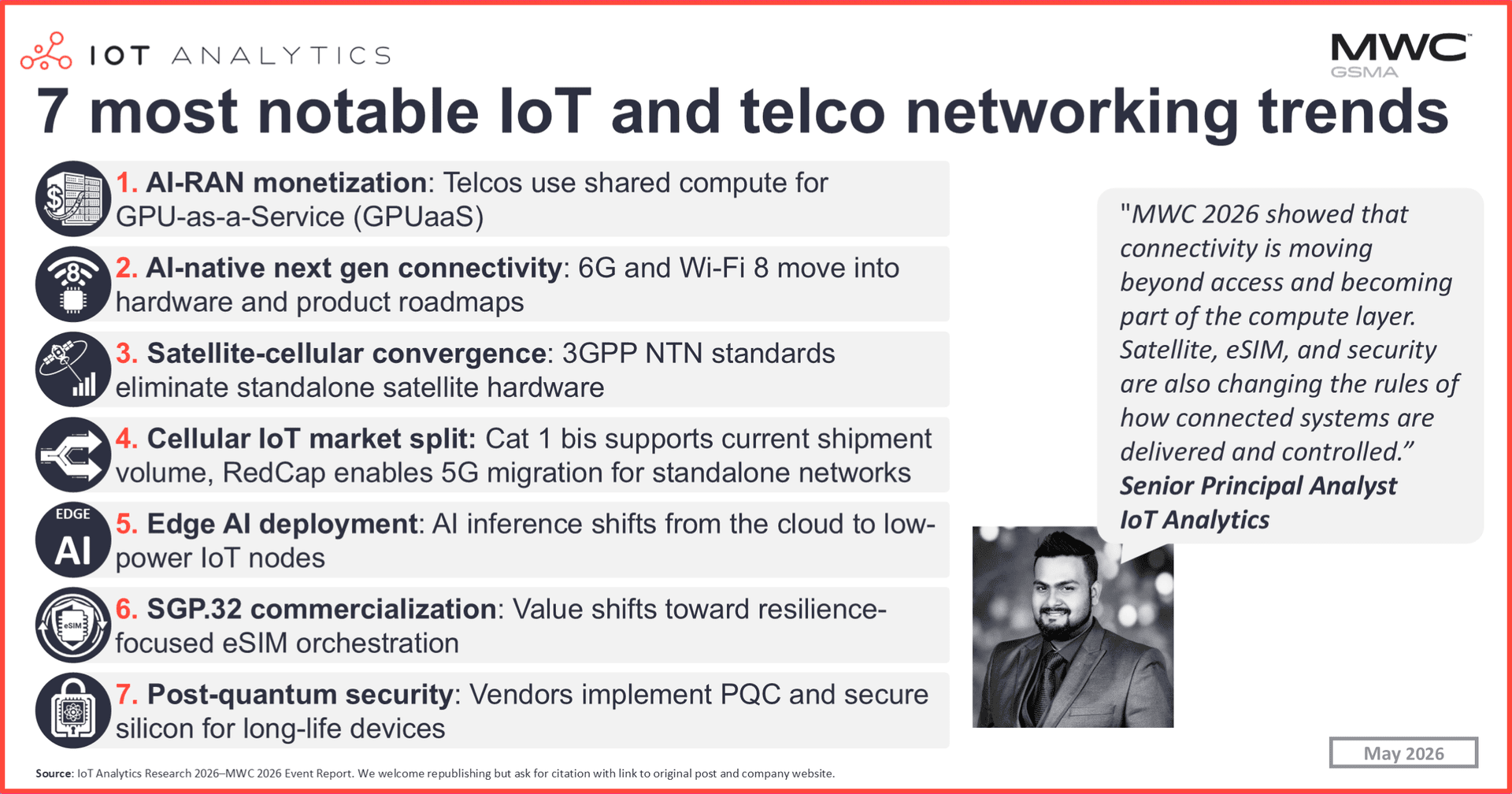
One of the clearest shifts was the repositioning of AI-RAN. Rather than presenting AI in the radio access network only as an optimization tool, several vendors framed shared compute infrastructure as a way for operators to monetize capacity beyond connectivity. Fujitsu, for example, positioned AI-RAN around shared GPU resources that could support GPU-as-a-Service or AI services when not consumed by RAN workloads.
This matters because it changes the investment logic for operators. If AI-RAN infrastructure can support both network processing and enterprise inference workloads, telcos may seek to justify future network spending through compute revenue as well as subscriber revenue. The practical constraint is equally clear: operators will need sufficient demand density and operational sophistication to turn spare compute into a service, which will not apply uniformly across markets.
Cellular IoT is splitting rather than upgrading in one direction
For IoT device makers, the cellular module picture presented at MWC was notably fragmented. Cat 1 bis is being treated as a near-term volume technology, while RedCap and eRedCap are positioned as the 5G migration path where 5G standalone networks and suitable use cases exist. Nordic Semiconductor’s Cat 1 bis module launch, Quectel’s RedCap module activity and Sequans’ migration positioning all point to a market that is dividing by deployment reality rather than following a clean standards ladder.
A concrete implication for OEMs is that module selection is now a regional network availability decision as much as a technical one. A product designed for broad coverage and long life may still favor Cat 1 bis, while a device intended for markets with mature 5G standalone infrastructure may have a clearer path toward RedCap. That trade-off affects bill of materials, certification planning, power budgets and lifecycle support.
Satellite IoT moves closer to cellular workflows
Satellite connectivity was another major theme, but the notable development was not simply more satellite coverage claims. The more specific change is the integration of non-terrestrial network technology into cellular standards, modules, SIM workflows and operator partnerships. SpaceX discussed second-generation Starlink plans using 3GPP 5G NR-NTN for satellite-to-user links, while Deutsche Telekom, Vodafone, AST SpaceMobile, Orange, Telefónica and others were associated with satellite-to-mobile or multi-orbit connectivity initiatives.
On the device side, Nordic Semiconductor’s nRF9151 added 3GPP-compliant GEO and LEO NTN support alongside LTE-M and NB-IoT. For system integrators and enterprises, this points to a more manageable architecture than separate proprietary satellite hardware, although coverage, service availability and cost will still need careful validation for remote asset tracking, fleet monitoring and safety-related use cases.
Edge AI reaches low-power nodes
MWC also showed AI moving into lower-power IoT endpoints rather than remaining confined to gateways, cloud platforms or high-end edge servers. SG Wireless demonstrated TinyML over LTE-M for local person detection, sending metadata rather than raw video. Nordic linked on-device inference to cellular IoT and NTN modules, while Semtech’s approach kept intelligence in the device or partner MCU with LoRa connectivity.
The deployment logic is straightforward: when connectivity is constrained, expensive or intermittent, local inference can reduce traffic and cloud dependency. This is particularly relevant for battery-powered and remote devices, where transmitting raw sensor data may be less attractive than processing events locally and sending only what matters.
SGP.32 moves into commercial use, but orchestration is the real layer
SGP.32 was another area where MWC showed commercialization rather than only standards discussion. Tele2 IoT, IDEMIA Secure Transactions and Cisco announced a commercial end-to-end SGP.32 IoT solution, while IDEMIA disclosed more than 15 commercial deployments and 40 proofs of concept. Other companies including Telit Cinterion, Emnify and Soracom showed demos, pre-order activity or customer testing.
The distinction from typical eSIM announcements is important. The value is not just the ability to download or switch profiles; it is the orchestration layer that determines when and why profile changes should occur across fleets, operators and regions. For connectivity providers, this shifts differentiation from SIM supply toward policy, automation, compliance and operational control.
Security planning moves toward long-life device risk
Security discussions at MWC included post-quantum cryptography, secure silicon and compliance readiness. ICTK introduced PQC physical unclonable function security chips for USIM and eSIM, Thales linked hybrid PQC to eSIM-related security flows, and Pairpoint and Lantronix signed an MoU around PQC protection for existing industrial IoT routers and gateways.
This is distinct from routine cybersecurity messaging because the focus is on devices that may remain deployed for 10 to 15 years. For industrial players and infrastructure operators, the relevant question is not only whether today’s encryption works, but whether devices shipped now can be maintained against future cryptographic and regulatory requirements, including secure update and remediation workflows.
Taken together, the IoT Analytics findings suggest that MWC 2026 was less about a single headline technology than about architectural convergence. Connectivity, compute, identity and security are becoming interdependent design choices. For IoT buyers, that means procurement decisions will increasingly need to account for network maturity, silicon roadmaps, satellite fallback, eSIM control and long-term security obligations from the start of a project.
- Telcos are using AI-RAN to explore shared compute infrastructure
- Vendors are moving 6G and Wi-Fi 8 future talk into AI-native connectivity roadmaps
- Mobile operators are integrating satellite and NTN technologies into cellular and IoT connectivity workflows
- Module vendors are splitting cellular IoT into Cat 1 bis volume now and RedCap/eRedCap migration next
- Vendors positioning edge AI at low-power IoT nodes
- Companies are commercializing SGP.32, but value is shifting to eSIM orchestration
- Vendors are moving IoT security toward post-quantum readiness and secure silicon
The post MWC 2026 signals a split IoT connectivity market shaped by AI, NTN and eSIM orchestration appeared first on IoT Business News.