












The push toward “massive Internet of Things (IoT)” is reaching a critical inflection point. As recently highlighted in IoT Business News coverage of the LoRa Alliance positioning Long Range Wide Area Network (LoRaWAN) as a foundational layer for massive IoT, the industry is racing to connect billions of remote assets. Yet, the sharpest edge of this challenge lies in the metering industry. Utility providers are under immense pressure to ensure remote water, gas, and electric meters remain reliably connected over 10 to 20-year battery lifespans. As these deployments expand beyond the reach of traditional cellular towers, Non-Terrestrial Networks (NTN) have emerged as the inevitable solution.
However, a dangerous narrative is taking hold across Original Equipment Manufacturer (OEM) design teams: the belief that 3rd Generation Partnership Project (3GPP) Release 17 allows for native NTN support over existing Narrowband IoT (NB-IoT) and Long Term Evolution for Machines (LTE-M) protocols via a simple Firmware Over-The-Air (FOTA) update.
While technically true for the baseband processor, attempting to bridge terrestrial and satellite connectivity strictly through software is a losing battle against physics. Transitioning a terrestrial technology stack to incorporate NTN almost universally dictates a hardware reconfiguration and, at minimum, a Printed Circuit Board (PCB) redesign.
The RF and Antenna Physics
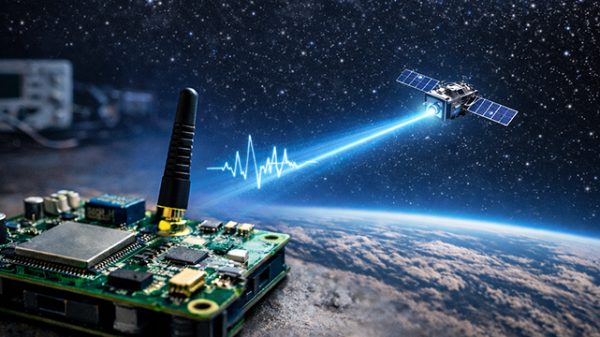
Standard cellular modules are optimized for terrestrial base stations sitting on the horizon. NTN, utilizing Low Earth Orbit (LEO) or Geostationary Earth Orbit (GEO) constellations, requires Radio Frequency (RF) propagation directed toward the sky. Even when operating on similar frequencies, the antenna pattern, gain requirements, and polarization are fundamentally different. The RF Front-End (RFFE) must be reconfigured to handle dedicated satellite frequencies, demanding new amplifiers, filters, and a redesigned matching network on the PCB.
The System-on-Chip (SoC) Integration Reality
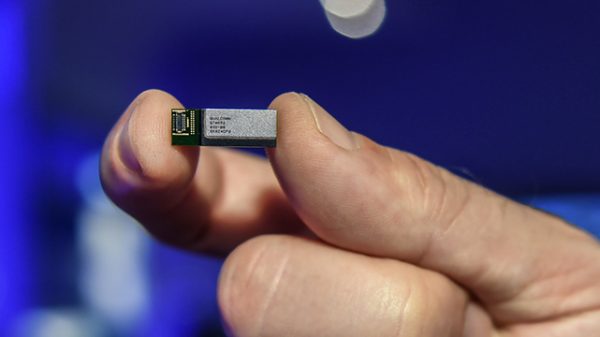
Silicon vendors are increasingly shipping highly capable, NTN-ready SoCs. Integrating a new STMicroelectronics (ST-MICRO) hardware architecture, for instance, unlocks incredible edge-processing potential and streamlines the commissioning process. However, swapping to an NTN-capable chip or flashing new firmware does not magically alter legacy copper traces. The signal must still be physically routed effectively to the sky, forcing a PCB spin.
Power and Thermal Management for the 20-Year Horizon
In the metering space, battery life is the ultimate currency. Satellite communication introduces extreme path loss. To compensate and close the link margin, devices require significantly higher transmit power than a standard terrestrial ping. The Power Management Integrated Circuit (PMIC) and the underlying battery profile must be engineered to handle the current draw of satellite transmission without browning out the device or prematurely draining a cell meant to last two decades. Accommodating this requires larger capacitors and altered power routing; directly impacting the Bill of Materials (BOM) and demanding a hardware revision.
Doppler Shift and Timing
LEO satellites move at approximately 7.5 kilometers per second, creating massive Doppler shifts. While modem firmware handles algorithmic compensation, the hardware oscillator, usually a Temperature-Compensated Crystal Oscillator (TCXO), must be of highly stringent quality to maintain frequency stability. Legacy terrestrial hardware often relies on lower-tier oscillators that fall out of tolerance under NTN requirements.
As enterprises formulate their connectivity strategies for 2026 and beyond, a topic explored in IoT Business News’ recent analysis of Broadband vs. Narrowband IoT for enterprise connectivity strategies, it is vital to separate marketing from engineering. Positioning an NTN integration as a mere software update ignores the physical realities of remote connectivity. For massive IoT to succeed, particularly in long-lifecycle industries like metering, OEMs must embrace the hardware design cycles, BOM revisions, and new PCB layouts required to successfully look to the stars.
The post The Firmware Fallacy: Why Bridging the NTN Gap in Massive IoT Still Requires a Hardware Reality Check appeared first on IoT Business News.