












Zackat Labs has launched a connected worker-safety platform built around its W3 wearable, a Bluetooth-linked gas monitor, AT&T cellular IoT connectivity and device management through AT&T Control Center.
Industrial safety monitoring is moving beyond fixed detectors and periodic checks because many of the risks in field operations are both mobile and personal. Heat stress, fatigue and gas exposure do not always occur where a facility has installed instrumentation, and supervisors often need usable alerts rather than another stream of raw sensor data.
That is the context for Zackat Labs’ new connected safety platform, which combines the company’s W3 wearable monitoring device with an integrated gas monitor and cellular IoT connectivity from AT&T Business. RCW Energy Services, a Texas-based provider of water management and support services for oil and gas, industrial and construction operations, is both a customer and distributor of the W3 solution.
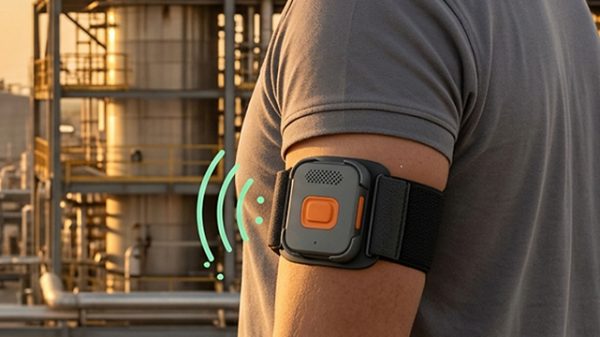
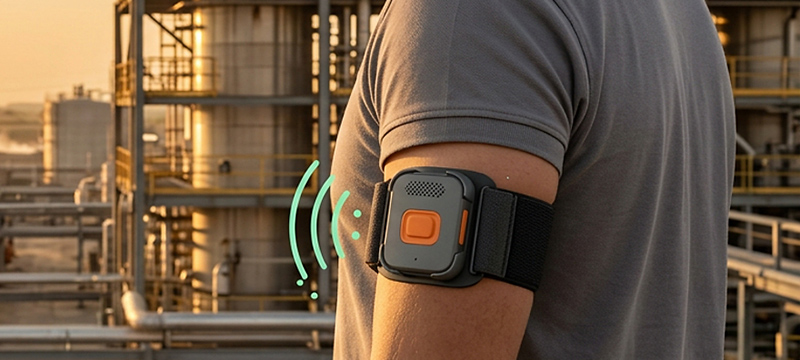
The W3 wearable is designed to track physiological indicators including core body temperature, heart rate variability and other signs associated with fatigue and dehydration. According to Zackat Labs, the system converts those inputs into warnings before a worker reaches a critical threshold, with alerts sent to supervisors’ mobile phones and to the W3 dashboard.
The environmental element comes from Zackat Labs’ single- and four-gas monitor, which connects to the W3 device over Bluetooth. Gas exposure alerts are delivered through the same connected application, rather than through a separate monitoring workflow.
A unified safety signal, not just another wearable
The differentiating feature here is not simply that a worker is wearing a connected device. Wearable safety products and gas monitors are both established categories. What makes this announcement more specific is the attempt to merge physiological heat-stress monitoring and gas detection into one alerting environment, with the gas monitor linked locally to the W3 and the platform then supported by cellular IoT connectivity.
That architecture matters for deployment teams. A Bluetooth link between the gas monitor and W3 suggests Zackat Labs is prioritizing a common field interface and alerting path rather than treating each safety sensor as an isolated connected endpoint. The trade-off is familiar in industrial IoT: simplifying supervisor workflows and connectivity management can reduce operational fragmentation, but it also makes pairing, device assignment and field procedures important parts of the deployment model.
AT&T Business’ role is also more than basic SIM connectivity. The company is supporting the W3 platform with cellular IoT connectivity for near real-time transmission of physiological and environmental data from field workers to supervisors and safety teams. Zackat Labs will also use AT&T Control Center to deploy and manage cellular connectivity across devices, including provisioning, activation and ongoing oversight through a single portal.
For connectivity providers, this is the type of use case where device lifecycle management is as important as network access. Wearables used by distributed crews need to be activated, monitored and supported across changing job sites and work teams. The press release does not disclose deployment scale, but the inclusion of Control Center indicates that Zackat Labs is preparing for centrally managed device fleets rather than ad hoc connectivity.
Why it is relevant to industrial IoT buyers
The announcement fits a broader shift in industrial IoT from asset-centric monitoring toward worker-centric telemetry. Oil and gas services, construction and industrial field operations often involve temporary sites, mobile crews and environmental exposure that cannot be fully covered by fixed infrastructure. A connected wearable can follow the worker, while a gas detector remains tied to the immediate operating environment.
For enterprises, the practical value will depend on how alerts are integrated into safety processes. A warning sent to a supervisor’s phone is useful only if escalation procedures, worker check-ins and incident documentation are defined. System integrators working with this type of platform will likely need to focus less on sensor installation and more on workflow integration: who receives alerts, how they respond, and how dashboard information fits into existing environmental health and safety systems.
OEMs and device makers can also read the launch as another sign that industrial wearables are becoming part of broader connected-safety stacks rather than standalone gadgets. The combination of body-state monitoring, Bluetooth peripheral integration and cellular backhaul reflects a layered approach: on-body sensing, local environmental sensing, mobile or dashboard alerting, and managed IoT connectivity.
RCW Energy Services’ involvement gives the platform an initial field-services context. The company serves oil and gas, industrial and construction markets and is distributing W3 solutions while using the technology for its service technicians. That does not by itself prove broad market adoption, but it does place the product in the type of operational environment where heat stress awareness and gas hazard monitoring are both relevant.
The key takeaway for IoT professionals is that Zackat Labs is not positioning W3 as a general wellness wearable. The company is building a connected safety platform around specific industrial risks, with AT&T handling the cellular management layer and RCW providing a route into field-service operations. Its success will depend not only on sensing capabilities, but on how reliably the alerting chain performs in the messy operational reality of crews, supervisors, devices and hazardous worksites.
The post Zackat Labs Combines Wearable Heat-Stress Monitoring and Gas Alerts on AT&T Cellular IoT appeared first on IoT Business News.