












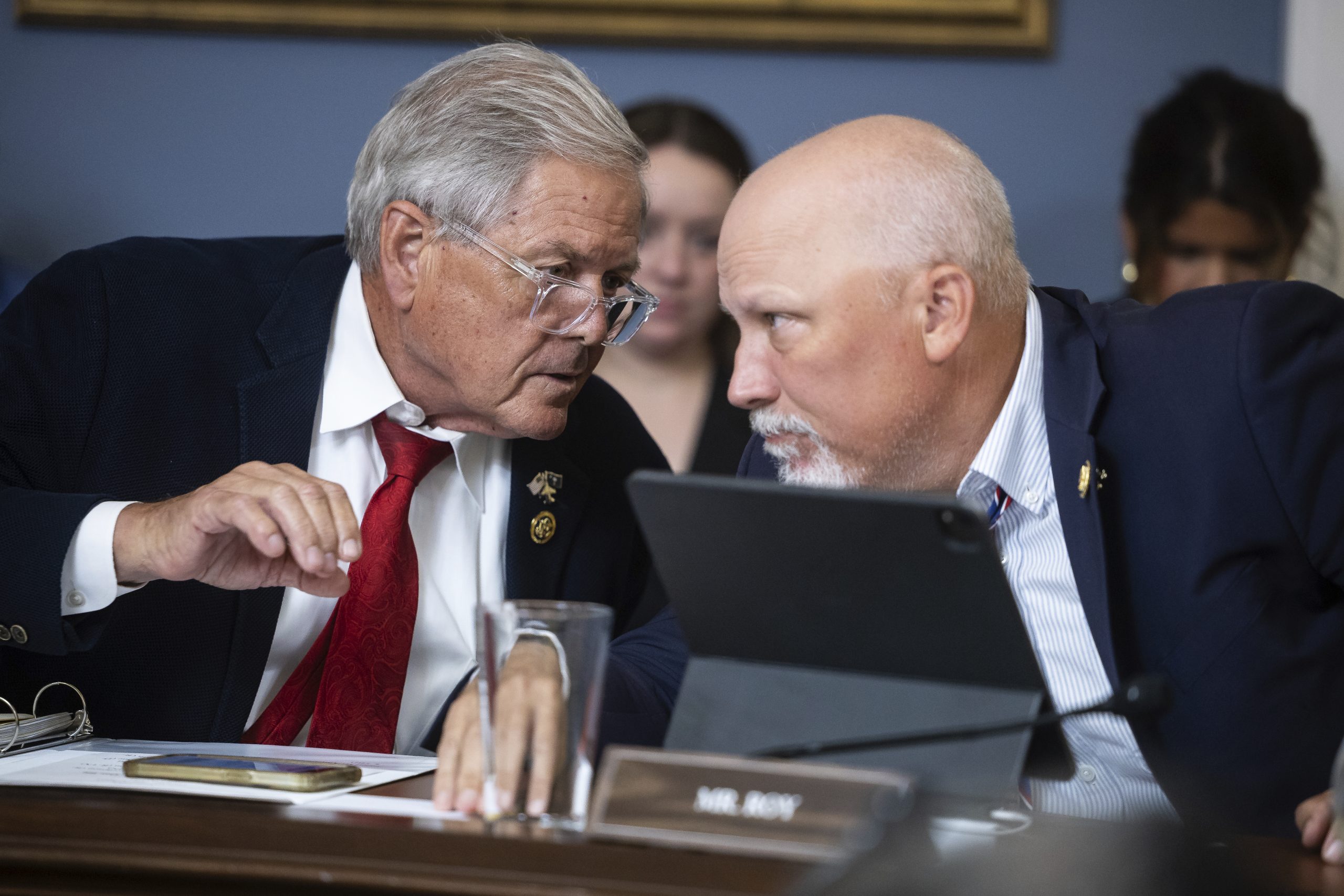
Fiscal conservatives in Congress threatened for months to block government funding if GOP leaders didn’t shun earmarks. They succeeded in scrapping just one; the rest, almost $16 billion worth, are slated in the package the Senate needs to clear by Friday to avoid a shutdown.
Republican hard-liners on both sides of the Capitol have made things difficult this winter for their leadership, which has been scrambling to fund the government before cash runs out Friday for the vast majority of federal agencies. But they failed to significantly curtail the practice of directing federal dollars to specific projects back home.
Republicans swore off earmarks for more than a decade in 2010 amid corruption scandals and demands from conservatives empowered by the rise of the Tea Party movement that has since receded. Then in 2021, Democrats brought back the practice after the party swept control of the White House and Congress, softening the return with a rebrand as “community project funding,” new rules to prevent abuse and a cap at 1 percent of funding.
Now Republicans run Washington once again, and they’re overwhelmingly embracing the renaissance. As the Senate considers a nearly $1.3 trillion funding package this week loaded with thousands of earmarks for projects in specific congressional districts, fiscal hawks are acknowledging defeat.
“When a majority of the United States House and a large chunk of the Senate seemingly want to advance earmarks, there’s only so much you can do,” Rep. Chip Roy (R-Texas), a member of the House Freedom Caucus, said in an interview.
“I’ve long stated I think it’s the currency of corruption, and we shouldn’t do it,” he added. “But, you know, members like to do it.”
Capitol Hill’s most vocal earmark proponents argue that, if not for the revival of earmarks, congressional leaders would not have succeeded in clinching bipartisan deals to fund the Pentagon and nondefense agencies with new budgets for the first time in almost two years.
The multibill funding package has yet to reach President Donald Trump’s desk and is now complicated by Democratic outrage over ICE funding after a federal immigration enforcement agent fatally shot another U.S. citizen in Minnesota over the weekend. But lawmakers in both parties are already touting the cash they secured for local projects as they campaign for reelection nine months out from the midterms.
“It’s not worth being in Congress if you can’t find ways to help your district,” Rep. Mike Flood said in an interview.
The Nebraska Republican secured almost $30 million in projects for his district in the current slate of funding bills, including millions of dollars to repave roads, about $750,000 for police cruisers and $500,000 for improvements to a shelter for minors who would otherwise be in juvenile detention.
Flood argues the inclusion of earmarks ultimately helped Republicans negotiate funding bills that keep federal spending mostly steady — a top priority of congressional fiscal hawks. “For all the things that people say are wrong with Congress, this process is working. And it’s working well,” he said. “And we are bringing this in under budget.”
This month members of the House Freedom Caucus threatened to tank a preliminary vote on spending bills if GOP leaders didn’t knock out at least some earmarks. They were able to kill only one: a $1 million earmark Democratic Rep. Ilhan Omar secured for a community organization in her Minnesota district, in part because the address listed for the group was that of a restaurant.
House fiscal hawks made a final stand last week when they demanded, and received, a vote to nix hundreds of earmarks senators had worked to secure. That vote failed overwhelmingly, right before the House passed a funding package with a price tag of more than $1 trillion, with every earmark intact.
Rep. Ralph Norman, a member of the Freedom Caucus, said it was a “sad day” and called it “irredeemable” for a GOP-led Congress and White House to support the earmark-filled package. Norman said he now has no hope Republicans will ever do anything to get rid of earmarks.
“I wish it was different,” he said.
More than 70 House Republicans voted against killing the Senate earmarks. However, some hard-liners argue that it’s really the minority party driving the resurgence in a narrowly divided Congress.
“You need Democratic votes, right? So let’s not forget that,” said Rep. Scott Perry (R-Pa.), a former chair of the House Freedom Caucus. “I’m not here to apologize for, or validate, a bunch of garbage Republican earmarks. But we’d have a much better time at making sure those didn’t prevail if we didn’t need the Democrat votes.”
In the Senate, where Democratic buy-in is necessary to overcome the filibuster, fiscal conservatives delayed action on funding bills for more than a month following the end of the record-breaking government shutdown in November — in part due to their earmark concerns. Now that the final slate of funding bills is before the Senate, those same lawmakers are again demanding a vote to eliminate the pet projects.
Last week Sen. Rick Scott (R-Fla.), a leader of that charge, noted that in 2021 the Senate Republican Conference voted unanimously to maintain their rule against earmarks, a nonbinding prohibition many GOP senators were quick to flout.
“It’s time for Senate Republicans to follow our own rules. END ALL EARMARKS NOW!” Scott posted on social media.
The earmarks Congress has inserted in the new funding bills are the first of Trump’s presidency, since federal agencies have been running on stopgap funding patches for almost two years. Lawmakers in both parties see them as a way to protect their authority to dictate how federal money is spent as the Trump administration continues to shift and cancel billions of dollars in contravention of their wishes.
“It restores the institutional faith in Congress’ ability — albeit in a very small and minor way — to direct congressional spending and gets power back from any executive branch,” Tennessee Rep. Chuck Fleischmann, a senior Republican appropriator, said in an interview.
Many Republican lawmakers have been privately pressing GOP leaders to bring back earmarks for years, including as far back as 2016, when then-Speaker Paul Ryan halted a closed-door vote on restoring the practice.
At least under the old rules, earmarks were entwined with corruption. In the early 2000s, several lawmakers pled guilty to money laundering and bribery charges for abusing the practice. In the most high-profile of those cases, the late Rep. Randy “Duke” Cunningham (R-Calif.) admitted to accepting $2.4 million in bribes to secure earmarks.
Now Congress has much tighter rules governing the process, including a prohibition on steering money to for-profit organizations. Senior members of the Appropriations Committees who want to avoid a repeat of infamous earmarks scandals also closely vet the requests, said House Appropriations Chair Tom Cole (R-Okla.).
“We scrub them pretty hard, and honestly the Democrats do, too,” he said.
In a sign House Republicans are growing more comfortable with the practice, they are now discussing whether to expand earmarks in future funding bills to include education, health and labor projects, according to Rep. Robert Aderholt (R-Ala.), who chairs the panel in charge of that money. Only senators are currently allowed to specify projects for funding within those jurisdictions.
“There’s interest on both sides, as long as it’s done in a way that doesn’t make both sides feel uncomfortable,” Aderholt said. “Members want to have a little bit of say-so, because we do have the power of the purse.”
Jordain Carney and Meredith Lee Hill contributed to this report.